
Core, Blimey!
The Mackinderian worldview in Trump's National Security Strategy

According to a range of press reports, the troubling National Security Strategy released by the Trump administration earlier this month was only the shorter, public version of a longer internal document whose status remains unclear. The Trump administration has denied the existence of such a document, but various reports suggest that there were different drafts of the NSS, reflecting differing parts of the MAGA coalition, which is not necessarily united on some of the biggest issues. The Trump regime’s approach to China is a particular complexity: there are clearly some Trumpians that see the withdrawal from/hostility to Europe as a necessary prelude to confronting China, including the willingness to defend Taiwan militarily. Others prefer a worldview that prioritises “deterring a conflict over Taiwan” without any commitment to its defence. On the face of it, it is hard to imagine Trump being willing to shed the blood and treasure of Americans defending an Asian island that calls itself the Republic of China in a war against (the People’s Republic of) China, when he’s made it clear that he won’t lift a finger to defend Europe - which he regards as his own cultural heritage and one that is his preferred model for American culture. In support of this viewpoint, Trump’s recent decision to allow advanced AI chips to be sold to China points to a president focused on deals above worrying about “a quarrel in a far-away country between people of whom we know nothing.1”
A China policy focused on trade and carving up the world into spheres of influence seems more likely to be Trump’s policy. In this light, the earlier draft of the NSS talks of:
A “Core 5,” or C5, made up of the U.S., China, Russia, India and Japan—which are several of the countries with more than 100 million people. It would meet regularly, as the G7 does, for summits with specific themes.2
This mention of a “core” made me think of the work of Halford Mackinder. He was an Edwardian academic who was a pioneer of geopolitics. In 1904, Mackinder published The Geographical Pivot of History, in which he identified that the “Colombian” age (focused on the Americas), as he called it, was over: ‘the westward march of empire’ had concluded, and the future focus of world power would be on what he referred to as ‘the heartland’, effectively the middle of the Eurasian landmass, focused around the vast forests of Siberia, which he described as ‘the pivot region of the world’s politics’.
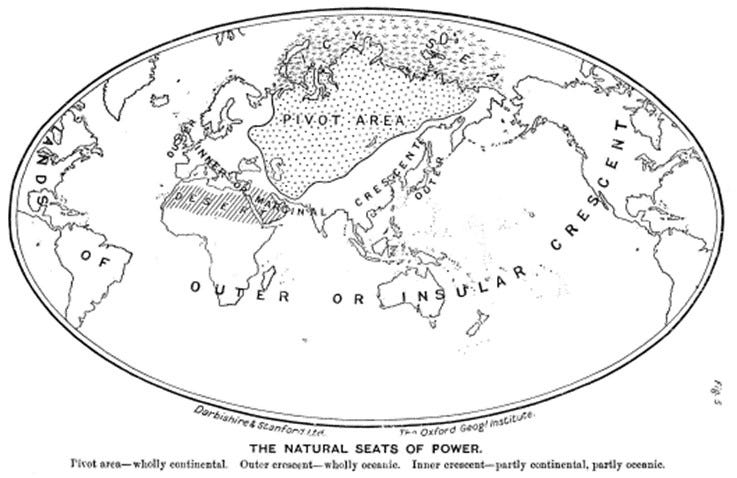
For Mackinder, control of this pivot, or core, of the ‘world island’ (the Eurasian– African land mass) offered such power that ‘the empire of the world would be in sight’ to whoever dominated it. In a later work, written in 1919, Mackinder summarised his theory in simpler terms:
Who rules East Europe commands the Heartland;
who rules the Heartland commands the World- Island;
who rules the World- Island commands the world.
Mackinder has been hugely influential on strategists and imperialists, including both Nazis (to his dismay) and modern Russian nationalists such as Aleksandr Dugin, who has pushed the idea that Russia must control Eastern Europe in order to make itself invulnerable (an idea eagerly adopted by Vladimir Putin and which follows the concept of a Russian sphere of influence spreading across Europe). The irony is that, in the twentieth century, Mackinder was wrong: control of Eastern Europe and Russia did not confer world power on the Soviet Union. The ultimate power in the twentieth century proved to be in the ‘Colombian’/Atlantic space, controlled by the United States and its Western European allies. Russia’s vast, empty and austere territories in Siberia were of little interest to outsiders, and remained mostly uninhabited, even as they provided Moscow with ample natural resources. Even the devastating blitzkrieg of Hitler’s Operation Barbarossa never made it into Mackinder’s ‘heartland’, getting bogged down well inside European Russia.
However, the intellectual concept of grand ‘spheres of influence’ controlled by a small number of great powers is what sits at the heart of the C5 concept. And the inclusion of Russia, China and India, whilst ignoring Europe completely, returns us to the Mackinderian worldview of a global ‘Heartland’ or Core, in which Russia controls Europe, Asia is the sphere of India, Japan and China and the Americas are under the USA (in which the NSS specifically seeks an enhanced version of the Monroe Doctrine which it calls the Trump Corollary). For the USA this ‘sphere’ would allow its ambitions to annex Greenland and Canada whilst China and Russia focused on their own geopolitical backyards. These ideas are attractive to fascists and authoritarians because they contain a beguiling sense that the world can be run by a small number of ‘great men’ such as Trump, Putin and Xi, without the troublesome meddling of committees, elections and representative institutions of the sort that the European Union tends to personify.
Whether anything comes of the C5 concept depends to a large degree on whether the Trump administration has the staying power to bring it to bear, and whether they actually care to, when they might focus on enriching themselves with crypto scams or hotel developments. But they are already trying their hardest to give Russia control of Europe, although Europe is showing its own staying power - something that is often underestimated. (see the post below)

But there is another factor which might drive a move towards a ‘C5’ world: climate change. A warming world, finally gives Mackinder’s ‘pivot’ theory some validation. This great northern hemisphere land mass of the World-Island might come into its own, as a place to live, to grow food and to extract resources. The Russian Federation might be a corrupted, ramshackle totalitarian state at present, but its territory might become the most important place in the warming world, perhaps dominated by Chinese economic interests as a result of Russia’s mortgaging itself to China to secure support for its war on Ukraine. How that contrast, between government and territory, plays out might prove to be the most important geopolitical question of the climate crisis era and one that, ironically, given Trump’s insistence that global warming is a ‘hoax’, might give Trump’s C5 foreign policy a boost that makes it relevant. A China-Russia axis controlling the newly useful lands of north Asia might, for the first time in human history, become a genuine world ‘Heartland’ for huge numbers of people. This isn’t a prospect I view with any delight or anticipation, but which might be an unstoppable outcome of the climate crisis, one which Trump’s policies accelerate.
These are all issues that I explore in greater detail in my forthcoming book Elemental, which you can now order via Bookshop.org ensuring that your purchase supports independent bookshops. And, you get a bit of a discount!
This was Neville Chamberlain’s line about Czechoslovakia which was, to some extent, a humble-brag since Chamberlain took the trouble to find out a fair bit about that country, even if his appeasement policy has been rightly criticised by historians. Trump, on the other hand refuses to learn anything from anyone.