

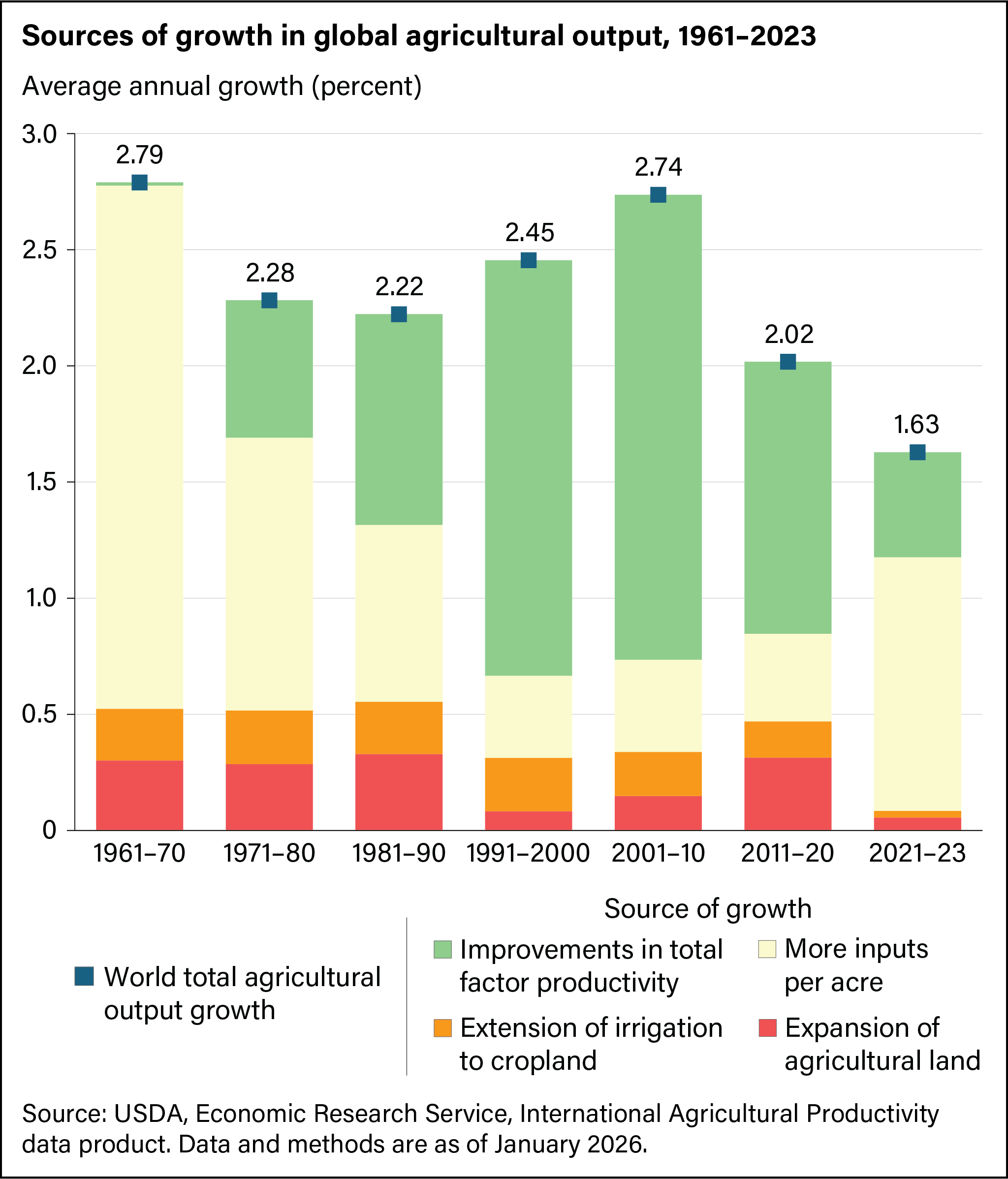
In 1798, the English economist Thomas Malthus wrote An Essay on the Principle of Population in which he postulated a near future with a global population unable to feed itself. This crisis would ultimately correct itself as a result of starvation and widespread mortality. As Malthus wrote: ‘Famine seems to be the last, the most dreadful resource of nature.’ Since then, the concept of a Malthusian Crisis has largely been dismissed as a gloomy anachronism: where there have been terrible famines, such as in China as a result of chaotic Maoist policies, this has been due to the failure of a local or national food system, not a global shortage. When Malthus wrote, the world’s population was 800 million, a population which fed itself from unmechanised agriculture. In the intervening period the world has managed to absorb a population ten times larger and still be able to feed itself, thanks to continued improvements in agricultural productivity.
After the scorching northern hemisphere summer in which farmers across Europe and North America have written off harvests, the burning question is whether the earth can continue to provide that increased productivity. From Malthus onwards there are countless examples in history of people predicting that the world had reached its capacity limit for feeding its population. One such, from the Club of Rome, a respected think tank, was published in 1972 with the title The Limits to Growth. It was one of the first to use computer modelling and concluded that without a change to human behaviour, ‘the most probable result will be a rather sudden and uncontrollable decline in both population and industrial capacity’ during the twenty- first century.
Like Malthus, the Club of Rome was, happily, wrong: up to this point, human ingenuity has kept pace with the appetites of a growing world population, a world population that is also eating ever more meat, which requires more land and inputs to produce than growing vegetables. But that may not mean that the capacity for greater food production is limitless. And the climate crisis is the major geopolitical shock that changes the equation. In a world of climate breakdown, geography itself is no longer a fixed parameter. And all the evidence, whether in the wealthy countries of the Global North or the painfully poor lands of the Sahel, points in the same direction: agricultural productivity growth is falling as a result of the climate crisis. This would be a problem in a world where the population sits at 8 billion. It becomes a far more troubling problem with a global population of 10 billion, or even 11 billion by the end of the century.
To take some immediate evidence from this year, according to early September reports, the summer of 2026 saw Britain’s lowest cereal harvest since 1984. In continental Europe, France’s 2026 cereal harvest is set to drop by almost 8 megatonnes versus 2025; Germany’s by about 4 megatonnes. June’s heatwave, the hottest on record in western Europe, caused an estimated 2-2.3 billion euros in grain losses. Of course, it’s not a uniform picture: some crops have flourished in the dry weather, such as oilseed rape. And over the longer term, the ability of Europe to continue to grow food will be a matter of re-engineering agriculture for a hotter, dryer climate. It is not that it will be impossible to grow food here. But it is very likely to become much harder to keep increasing yields, year after year. And just to maintain productivity in a rapidly changing climate will require significant infrastructure investment in things like reservoirs, something that Britain isn’t very good at.
As I found when researching and writing my book Elemental, questions of food security have always played into geopolitical considerations. Vikings swept through medieval Europe looking for places where food was more plentiful than in their austere Nordic homelands. Yes, they sought power and loot, but food was one of their biggest priorities. During World War One, the Steckrübenwinter (turnip winter) of 1916– 17, a period of profound food shortages brought on by the combination of a failed potato harvest and the ongoing blockade, according to German estimates nearly 800,000 people died as a result of hunger. This trauma fed into Nazi obsessions around food security. The idea that Germany must not have to rely on imports became an important element of Hitler’s concept of Lebensraum. Rather than ship food across oceans, Germany must seize its neighbouring territories in Eastern Europe. There, on the fertile plains of Ukraine and western Russia, Germany’s people and particularly its army could be well fed.
That same territory is now part of a war for food in the 2020s. Vladimir Putin claimed he had various reasons for his decision to launch a full- scale invasion of the country in February 2022. There was the idea that Ukraine must not be allowed to choose a future as a member of NATO or the European Union. There was the offensive myth that Ukraine, with its Jewish president, was a neo-Fascist threat to Russia. And, in his essay ‘On the Historical Unity of Russians and Ukrainians’, Putin presented the idea that Ukraine was never a real country separate from Russia. But, in that essay, Putin also gave away some of the underlying fears that will have motivated his disastrous choice. He wrote of the ‘direct external control’ being exercised over Ukraine by Western powers. As part of this, Putin talked of economic takeover: ‘This is also a disguise for the takeover of the rest of the Ukrainian economy and the exploitation of its natural resources. The sale of agricultural land is not far off, and it is obvious who will buy it up.’ This was Putin’s way of signalling to Russians that the greatest natural asset of this ‘historically united’ land was being taken away by rapacious foreign interests.
The idea that food security was one of Putin’s justifications for his 2022 invasion of Ukraine is bolstered by the actions of his troops once they had control of prime agricultural land in Eastern Ukraine. A carefully worked out plan was put into place to seize Ukraine’s harvest, and according to one estimate, Russia stole or destroyed over 4 million tonnes of Ukraine’s 2022 harvest, using its grain ships to launder the stolen produce through international markets. But Russia is not just stealing the harvest. It is also stealing the land. Rather as associates of William the Conqueror were given territory in England after the Norman invasion of 1066, Russia’s largest private landowner, Alexander Tkachev, who is also a former minister of agriculture, has been a beneficiary of Russia’s war on Ukraine. According to the Oakland Institute, a US think tank, Tkachev has seized 400,000 acres of prime agricultural land in occupied Ukraine, apparently with the connivance of the occupying Russian military forces and, according to sanction documents, the Kremlin. It becomes increasingly clear that Russia’s war on Ukraine was in part a twenty-first century war for food: a war to seize prime agricultural land, a war to seize the production from that land and to redistribute the spoils to the associates of the leadership. Putin had realised, like countless military commanders throughout history, that food could be used as an instrument of war.
Another war for food is being fought at the moment in Sudan. In 2018, the United Arab Emirates (UAE), a high-consumption country with no agricultural land of its own, decided that it would not leave its food security to the mercy of the market. Its decision was driven as much by climate change as by any other factor. ‘We saw a world facing a climate crisis and an increasingly intense competition for food supplies. In the world we want to own our own supply chain, not just be buyers,’ an Emirati diplomat told me. ‘We will have a global array of agribusiness holdings in strategic locations, connected by the network of ports that we have been acquiring and building all over the world.’ This included the acquisition of 50,000 hectares of arable land in Sudan, soon to be expanded to over 200,000, all connected to a new port on the Red Sea controlled by the UAE government. Around the world, the UAE owns a million hectares of agricultural land spread across five continents.
The UAE’s decision to back the Rapid Support Forces (RSF) rebel group in Sudan’s civil war may in part be driven by ideological motives - a fear of Islamism above all - and a belief that the RSF is best-placed to limit that. But it is more about a desire to control the country in order to secure its resources: gold mines, minerals and prime agricultural land. In Sudan, it wants the RSF controlling the government in order that food supplies to the UAE are secured. From this flows a genocidal civil war that causes mass starvation. The Sudanese need to starve in order that the Emiratis, with one of the world’s highest rates of obesity, can stay the same shape.
So, as the climate crisis means that food becomes an ever more precious commodity, the attempts to control its flow will start to affect not just small and middle powers but even the world’s superpowers. Even China’s ability to risk an invasion of Taiwan depends to some extent on the degree to which it can stockpile food supplies to mitigate the risks of an embargo imposed by the United States. The long hot summer of 2026 points to a future in which countries take ever more radical actions to secure a dwindling resource.
Parts of this article come from my book Elemental - the New Geography of Climate Change and How We Survive It, which you can buy in all the usual book-buying places, such as here.