
Stranger Things
The 1980s Nostalgia of Trump's Foreign Policy is probably going to end up, like Stranger Things, as a horror show.

When I was working in Iraq in the aftermath of the 2003 invasion, I recall chatting to an American working in private security who had served in one of the Airborne regiments as a young man. He recalled that when they told him he was going to parachute into Panama as part of an invasion, he was green enough to think it was part of some hazing wind-up for newbies. Until they started getting on the plane and flying to Central America…
It’s a sufficiently good anecdote that I researched and found that it might be improbable, as there was lots of pre-invasion training of US forces in Panama - where thousands of US troops were already stationed as part of the arrangements for handover of the Panama Canal initiated by President Carter. Anyway, it’s a reminder that in the 1980s a US president ordered the invasion of a Latin American country, arrested its president on drugs charges, and sought to gain advantage for its companies, such as Bechtel which did well from the reconstruction phase.
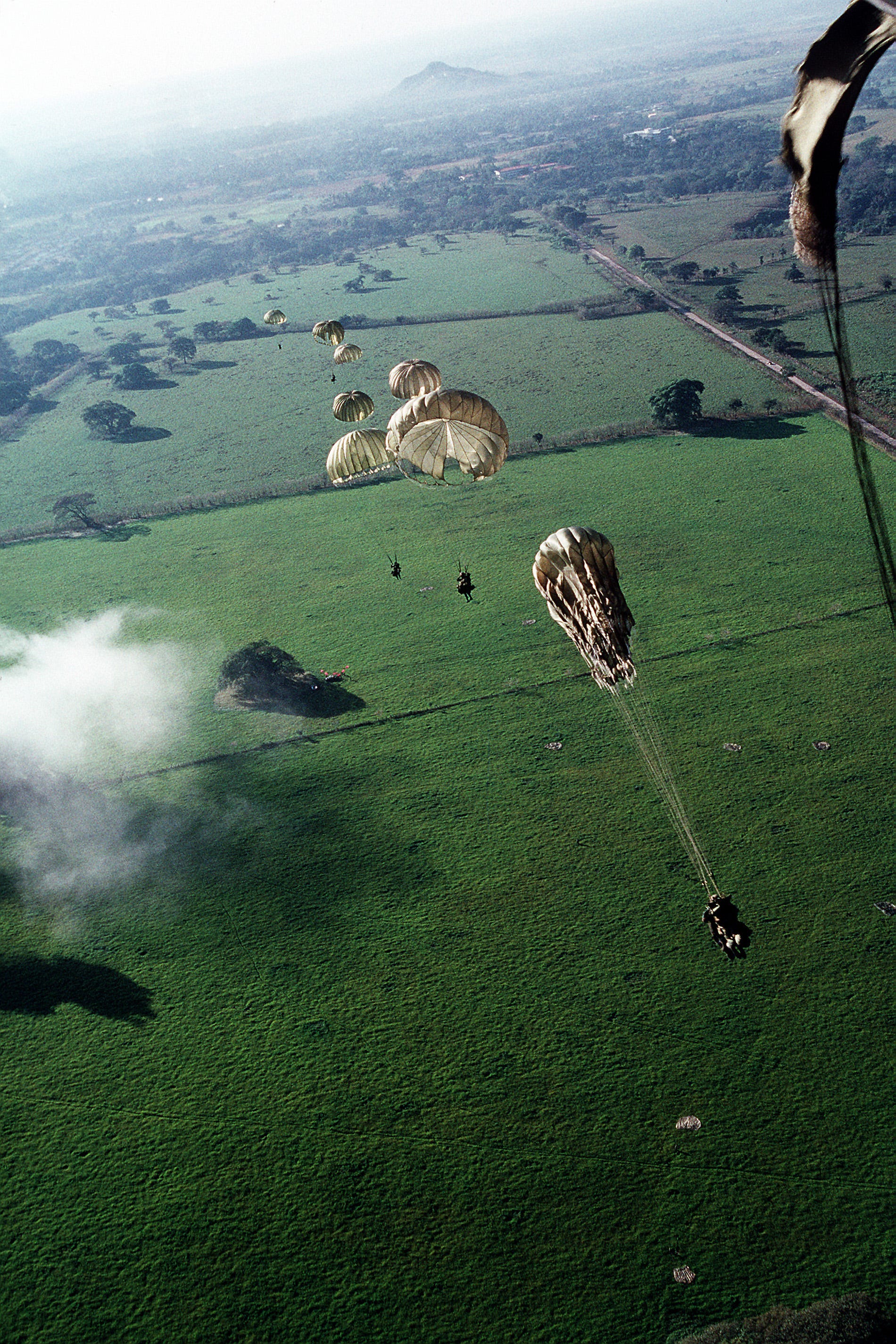
The 1989 invasion of Panama occurred under President George HW Bush, now seen as a paragon of WASP-y rectitude and an old-school Republican who ended the Cold War and stood up to Israel over illegal settlements. But Bush was still happy to greenlight a military operation of questionable legality, without congressional authority and in flagrant denial of basic principles of sovereignty. The fact that it occurred against a nearly unarmed country (Panama had a tiny ‘defence’ force that had no ability to stop the US) in America’s backyard probably made it a lot more attractive as an operation. Cynics observed that Bush might have been motivated to remove Noriega as he had been a key contact of the CIA at the same time as being heavily involved in the drugs trade during the period that Bush was director of the agency.
Stranger things, even, had occurred in 1983 with the US invasion of Grenada, a tiny Caribbean island rightly famous for its beautiful beaches and production of nutmeg. The pretext on this occasion was rising Cuban communist influence on the island, and it is true that Cuban citizens ended up fighting US forces. But once again, the threat to the US was negligible, the military opposition faced was almost non-existent, and the questionable legality of the operations led to no real consequences for the leaders involved (in this case, Ronald Reagan). The cynical view is that the whole thing was designed to distract attention from the bombing of the US Marines in Beirut around the same time, an American humiliation at the hands of Hizbullah.
The good old days
As we are constantly reminded by his habit of falling asleep in public and increasingly demented behaviour, Donald Trump is the oldest US president ever to be inaugurated. For him, 1983 was something of a banner year, as he officially opened Trump Tower in Manhattan in February of that year. Trump’s ‘Make America Great Again’ slogan harks back to an era when, in his view, the United States was ‘strong’ and ‘respected’. Whilst Trump does not hold with President Reagan’s views on free trade, he often cites his foreign policy positively and he is clear that America was last ‘great’ in the 1980s. The idea of treating the Americas as a backyard for US interventions was particularly strong in the 1980s, whether in these military operations, or with the activities of the CIA in El Salvador and Nicaragua.
The 1980s were Trump’s glory years: in addition to his Tower, he published The Art of the Deal in 1987 and flourished in the greed-is-good culture of the era. Many of his favourite cultural references are to long-forgotten 1980s businessmen and celebrities. He first developed his obsession with tariffs and his antipathy towards NATO in the 80s, garnering national attention with ads he took out the New York Times to promote his views. By contrast, the next decade began with Trump’s first divorce (1990) and his first bankruptcy (1991), both activities he has repeated with some regularity.
Fast forward to 2025 and the top show on Netflix is a 1980s nostalgia-fest. Indeed, the first season of Stranger Things takes place in November 1983, just as the invasion of Grenada was winding down. Trump’s own views, and perhaps his entire personality, appears to have been frozen at some point around the time of the invasion of Panama, the cocksure attitude of a man of privilege in his thirties at a time when America was an economic powerhouse, winning the Cold War. All of this is the context for Trump’s invasion of Venezuela.
“It won't cost us anything”
The world awoke on 3 January to the news that US Special Forces had seized Venezuela’s President Maduro and his wife, as part of a wider military raid against the country. Later that day, Trump announced that the US would “run the country” - a vast, geographically diverse territory larger than Afghanistan in a state of dire poverty and governmental collapse. He said the US wasn’t scared of “boots on the ground” and there would be no cost to the US because it would all be paid for by the money made from US oil companies taking over Venezuela’s oil industry. In his nostalgia for the 1980s, Trump forgot one of the key lessons: invade or interfere in small places (Panama, Grenada, El Salvador) and there is not too much that can go wrong. Instead, he has allowed himself to get dragged into a place that has a larger land area than Pakistan with a population larger than Syria’s.
This is about much more than 1980s nostalgia, of course. In the US, presidents often turn to foreign adventurism as they see their domestic power ebbing away. The MAGA coalition has split apart in recent months over the Epstein issue, as well as the persistent economic problems caused by Trump’s tariffs. Trump is sufficiently unpopular that he wasn’t able to bully Indiana’s state senators into gerrymandering their reliably conservative state to gift him additional congressional seats for this year’s mid-terms. It is at moments like this that US presidents turn their attention overseas. When such a president is easily bored and lacks any sense of ideology or principle, the results are likely to be chaotic. In recent weeks, Trump has carried out an inexplicable airstrike in Nigeria, actioned further airstrikes against boats in the Caribbean and Pacific (Venezuela has no Pacific coastline) and now invaded Venezuela itself.
The particular challenge here is that Trump is doing something that is specifically one of the bugbears of his MAGA coalition. His Vice President JD Vance has railed against “stupid wars”, with direct reference to the regime change actions of previous GOP presidents in Iraq and Afghanistan. Already, his former MAGA stalwart, now opponent, Majorie Taylor Greene has posted “This is what many in MAGA thought they voted to end. Boy were we wrong.” Other MAGA leading lights, such as Tucker Carlson, Steve Bannon and Rand Paul have all expressed their objections to the move. As a matter of principle, Trump’s supporters want America out of foreign wars, not starting new ones.
The world may not need Venezuela’s oil
Then there is the inadequacy of his planning. As far as one can tell, Trump thinks that Venezuela will more or less run itself, with a layer of US authority, over the transitional figures from the Maduro regime, focusing on the oil. Anyone who knows anything about Venezuela’s energy sector will tell you that it needs billions of dollars of investment to become profitable again. It’s also the case that Venezuela produces heavy oil that is less sought after on world markets. And current global demand for oil is low - in spite of global uncertainty which normally pushes prices up, they are at levels not seen since COVID. The world may really not need or want Venezuela’s oil.
Then there is the poor political strategy: the basis on which Trump (and many other countries, including the UK) do not accept Maduro’s claim to the presidency is repeated stolen elections, the most recent of which was in 2024, when opposition figure Edmundo Gonzalez was regarded by most observers as the rightful winner. If Trump’s plan was to arrange some sort of transition of power, to him or to opposition leader María Corina Machado (recent winner of the Nobel Peace Prize), he might claim a veneer of international legitimacy for his actions. But in his press conference today (3 January) he declared: “I think it would be tough for her to be the leader. She doesn’t have the support or the respect within the country. A very nice woman, but she doesn’t have the respect.” He didn’t mention Gonzalez at all. He clearly doesn’t care about democratic legitimacy - which is hardly a surprise.
Instead, Trump claimed that the US was backing Venezuela’s vice-president as a transitional leader whilst the US would “run the country”. But Delcy Rodríguez, Venezuela’s vice president who was sworn in as interim leader, contradicted President Trump by rejecting U.S. intervention and demanding Nicolás Maduro’s return. To put it politely, this is a shitshow and nobody knows what they’re doing.
But Trump may not care. His attention is now probably focused on the money he wrongly thinks there is to be made from Venezuelan oil. The difficulty is, he is not a details guy and it’s rapidly becoming obvious that nobody has thought through the details. Essentially, the United States has taken over Venezuela by mistake. Stranger things have happened, but not many.