
Condemned to repeat?
Israel's short memory is odd for a country led by soldiers

Before I start, I’d like to offer an apology to regular readers (if indeed I have any left). I’m painfully aware that I have not posted here for some time. This is largely due to some very all-encompassing work commitments which have kept me from writing. Happily for me if not for you, these are mostly out of the way, although I still have lots of events coming up connected to Elemental. You can find a full list of them here, if you want to hear me speak about the book.
Castles in the Air
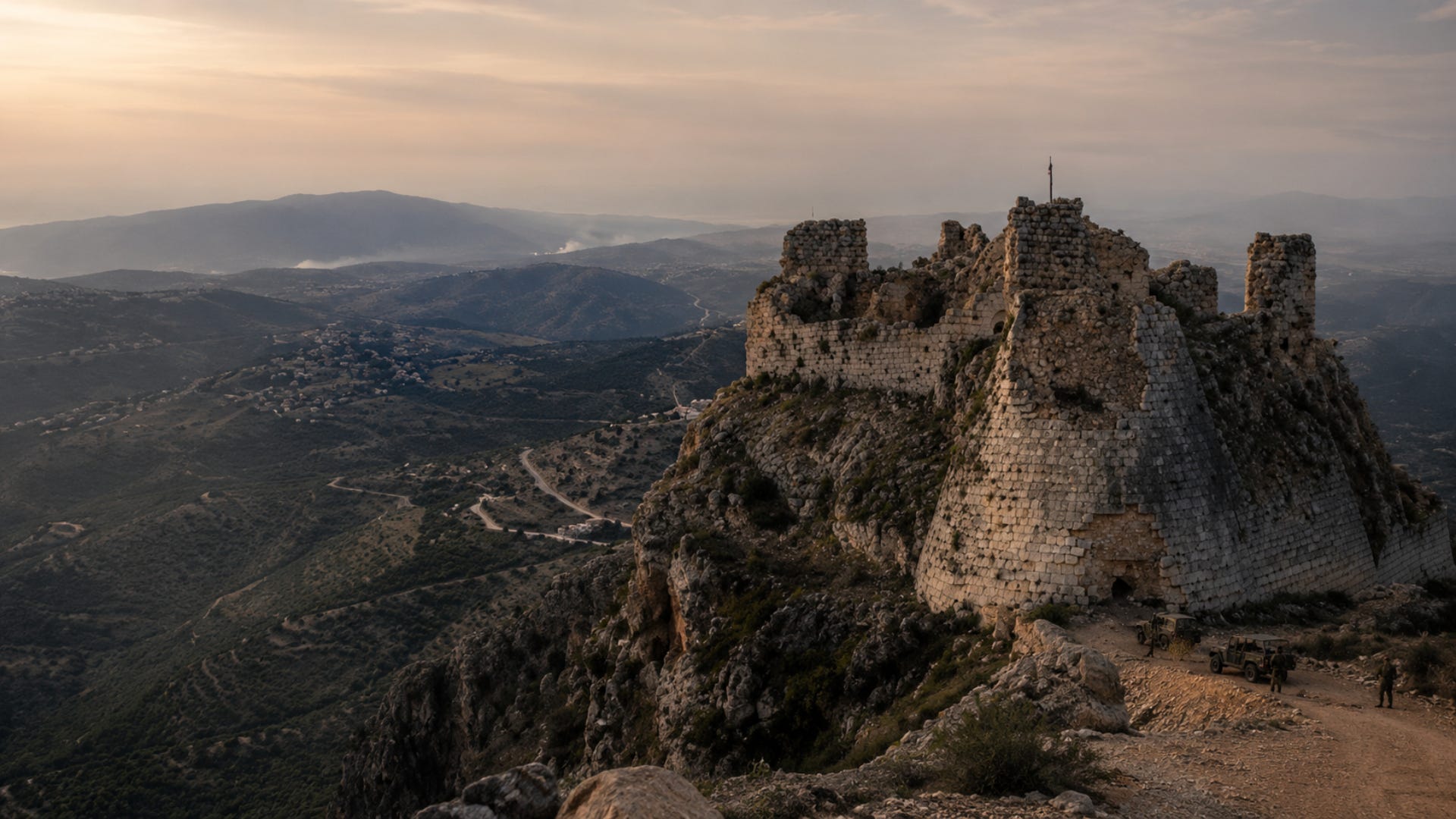
I woke on Monday morning to hear reports that Beaufort Castle, a crusader fortress in southern Lebanon, had fallen to the Israeli military. This led me to double-check that the year wasn’t 1190 when, in the aftermath of the Crusaders’ devastating 1187 defeat at the Battle of Hattin, almost all of the fortresses in Outremer (the Crusader kingdoms) fell to Saladdin.
Of course, I don’t really think that what happened with the Crusades, in which religious extremists fought with hideous violence over contested land in Palestine using dubious religious justifications, can be seen as analogy for current Middle Eastern conflicts. For one thing, Jews were not really combatants in the Crusades and the so-called ‘Christian’ Crusaders were often violent antisemites. Perhaps more importantly, whilst the geography of the Kingdom of Jerusalem and modern Israel are superficially similar, their status is completely different. The Crusaders’ kingdom was always marginal, vulnerable to oblivion. In the aftermath of the Battle of Hattin, Saladdin, who was ruler of Egypt even though he was himself Kurdish, controlled almost the entire territory. The famous Third Crusade of Richard the Lionheart was not a resounding victory but merely moved the Crusaders from a toehold to a micro-state, which was eventually wiped out.
By contrast the modern state of Israel has not faced an existential threat since the Yom Kippur War in 1973. Even then, it had an extensive nuclear arsenal and was prepared to use it against its enemies. In October 1973 it readied several atomic devices for use against Egypt and Syria. It decided against using them because its conventional forces prevailed. The Hamas massacre of 7 October 2023 was not an existential threat, even if it was a severe one involving hideous violence. Just because idiots march around in western cities saying “from the river to the sea” doesn’t mean there is any chance that Israel will end up, as the Crusader states did, in the sea. The Crusades are largely irrelevant to modern Israel, except for their capacity to be weaponised by Islamists who like to trigger their co-religionists with dodgy takes on medieval history.
On the other hand, there is part of the history of Beaufort Castle that is highly relevant to the events of the present day. Beaufort, which I visited in 2003, is in a beautiful and dramatic setting above the Litani River. The river bisects southern Lebanon and acts almost as a second frontier within the country. South of the Litani, Israel has made frequent incursions; past the Litani these have been fair less common. But Israel has held Beaufort before, from 1982 when it was one of the key battles of that particular invasion of Lebanon by Israel (there have been invasions in 1948, 1967, 1971, 1972, 1973, 1974, 1975, 1978, 1982, 1993, 1996, 2006 as well as the current operation. If I have missed any, I can only apologise to the IDF. It’s hard to keep track.) In 1982, the Israeli seizure of Beaufort became a byword for the bravery of the ordinary soldiers, many of whom died storming the steep ground, cut down by machine-gun fire, contrasted with the callous incompetence of the leadership, with the Defence Minister Ariel Sharon announcing it had been taken without Israeli losses (he didn't bother to find out if there had been any) and Prime Minister Menachem Begin appearing surprised to learn that the Palestinian defenders had access to machine guns.
The Israelis held Beaufort until the year 2000, as part of its occupation of Southern Lebanon. It was under constant attack and became a byword for Israel’s failed occupation. The purpose was to hold a “security zone” in Lebanon and work through its proxy, a Christian militia called the South Lebanon Army, to limit Hezbollah and related terror groups. As always, Israel had endless tactical victories against Hezbollah. But the group continued to grow and develop its ability to target Israel. A much bigger invasion in 2006 had the same effect. The 2024 exploding pagers attack managed to amaze the world with the ruthless ingenuity required to carry out such a plot, at the same time as having no lasting ability to stop Hezbollah from attacking Israel.
The thing that stopped Hezbollah from firing at Israel was a ceasefire deal struck in November 2024. When Israel participated in the attack on Iran this year that led to the death of Ayatollah Khamenei, Hezbollah, clearly not militarily defeated, started firing rockets again at Israel. Since 2006 there has been a requirement on Lebanon’s government to disarm Hezbollah. Plenty of ordinary Lebanese are opposed to the Shi’a militia. But Lebanon’s government, admittedly corrupt and incompetent (although corruption is relative - it is clearly not as corrupt as the United States government) is also grappling with incredible challenges and limited resources. Lebanon has more refugees as a proportion of its population than any other country. Thanks in large part to continued Israeli assaults, it has poor infrastructure and a weak military. If Israel wanted the Lebanese government to be better placed to deal with Hezbollah itself, it has gone about it in a funny way.
Much has been made of Trump’s stupid decision to wage war with Iran. But he is clearly a stupid man. I don’t think anyone thinks Benjamin Netanyahu is stupid. He might be amoral, dishonest, corrupt and untrustworthy. But he isn’t stupid. Which makes his failure to learn the lessons of history all the more surprising.