
America's Oil Rush
The World's Leading Proponent of Climate Denial is Enjoying an Unprecedented Oil Rush. Money talks.

As we emerge into a brief respite between heatwaves striking Europe, the insistence by the Trump Administration that climate change is “the scam of the century” seems hard to understand. It’s not as if America, facing wildfires, rising sea levels and extreme heat, doesn’t have its own evidence of what’s happening. But its politicians, especially of the MAGA variety, seem bizarrely fixated on ignoring and denying it. There could be many reasons for this, but one, simple but often ignored, is the massive transformation of America’s own energy industry.
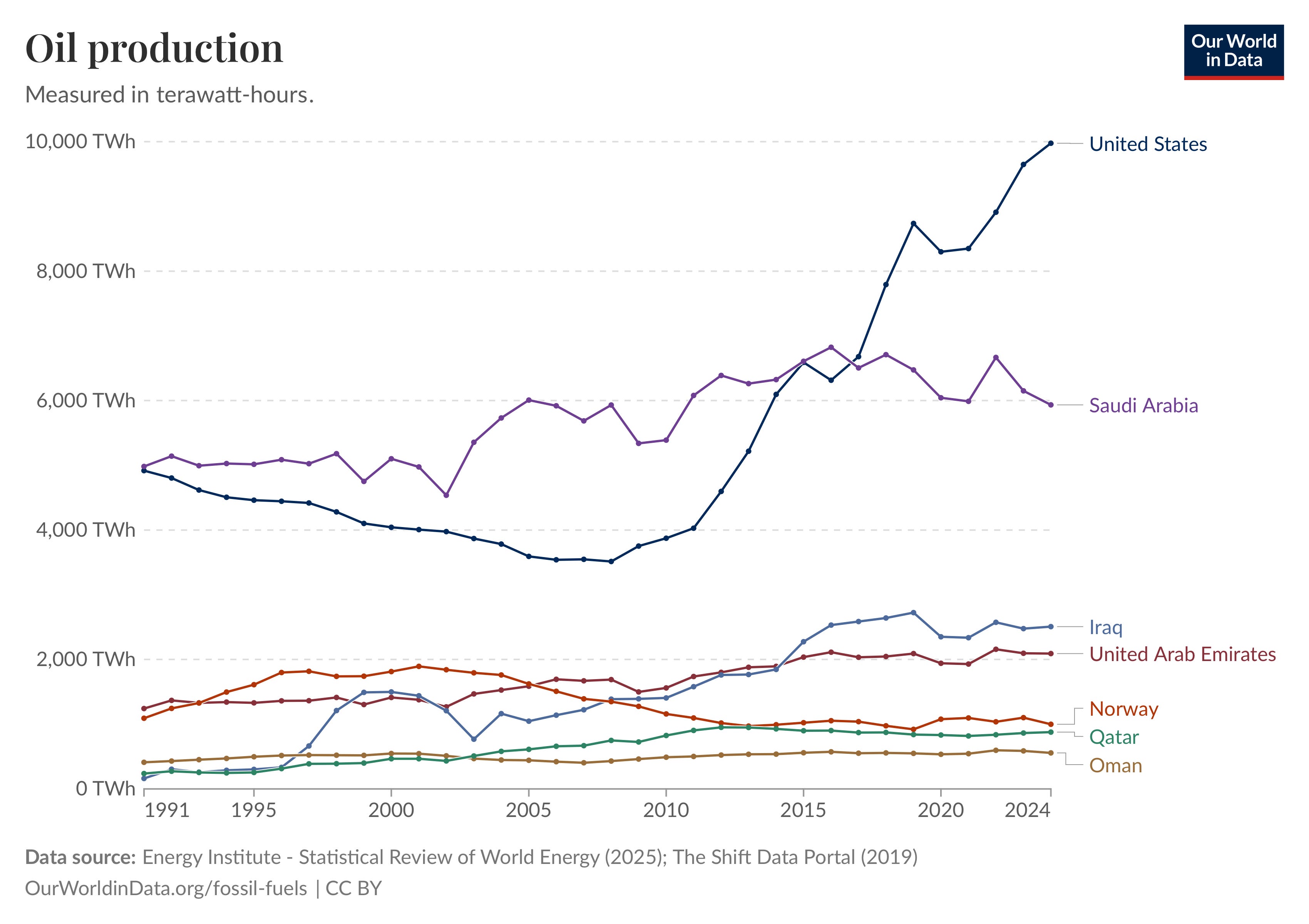
In 1991, the year of the first Gulf War, America and Saudi Arabia produced oil at the same rate, but over the following two decades, US oil production fell as Saudi Arabia’s rose. And then, from 2008 onwards, an oil revolution occurred in the United States, largely as a result of new extraction techniques, such as fracking and horizontal drilling that allowed previously uneconomic reserves to be exploited. It’s worth noting the scale of this increase: US oil production more than doubled in the next ten years, an increase greater than the entire output of Saudi Arabia. America’s economy is huge, so of course the oil production sector doesn’t assume a systemic importance within the overall economy of the country, as it does with Saudi Arabia. Nonetheless, this represents trillions of dollars of revenue for oil producers.
Shortly after the shale revolution, another historically important shift occurred in the United States: the Supreme Court’s 2010 Citizens United decision effectively lifted all caps on political donations by businesses. The combination of these two factors has been a massive bonus for a corrupt president, representing a particular opportunity. Trump has never hidden the idea that his agenda is for sale, but in the case of fossil fuels, he was perhaps even more blatant than for other sectors. In April 2024, during the presidential campaign that year, Trump met fossil fuel executives and offered a “deal”: one billion dollars in donations in return for all the policies they could dream for from “day one”.
Perhaps showing itself to be a little cheap, analysis suggests that the fossil fuel industry only spent $220 million to get Trump elected. But either way, it has proved a good deal: as well as proclaiming that climate change is a hoax, Trump has opened up protected areas to oil and gas development, reversed incentives for people to buy EVs, and waged a propaganda war against wind energy, which has become the cheapest and simplest way to generate power, in spite of what Trump claims. Most significant, the now-misnamed Environmental Protection Agency rescinded something known as the “Endangerment Finding”, which since 2009 had held that greenhouse gases endangered human wellbeing. In reversing this, Trump’s EPA pulled out the foundations of most of the United States’s environmental regulations.
So much analysis of the climate-denial movement in the United States is focused on cultural and ideological reasons when it might just be down to something much simpler: the government of the world’s largest oil producer, on the back of an unprecedented oil boom and a Supreme Court that believes its job is to favour the interests of private businesses, has been captured by the fossil fuel industry. Only when the long-term trend of falling demand starts to hit American producers will this start to have a real impact on the power of the fossil fuel lobby.